Social democracy in Luxembourg


The future of social democracy is not determined by opinion polls, but by its ability to translate values into concrete reforms – that is what I would like to reflect on in this article.
Social democracy in Luxembourg – once the debate on the party programme is over, the real work begins.
Over the past few weeks, I have had the opportunity to publish several articles on the future of the LSAP and the renewal of social democracy in Luxembourg. My aim was never to present ready-made answers, but rather to spark a discussion about the role the LSAP must assume in future if it is to once again become the defining social-democratic force in our country.
I therefore read Ines Kurschat’s article in the Luxemburger Wort on 1 August with interest. Regardless of differing perspectives, her analysis touches on many questions currently preoccupying numerous social democrats.
The article describes a party which, whilst gaining support in the polls, faces a deeper challenge: the search for a clear identity in a society that has undergone significant economic, social and cultural change. This assessment deserves attention.
Social democracy has always been successful when it has not merely described change, but shaped it. It has combined social progress, economic development and social cohesion. That is precisely where its task lies today.
Luxembourg in 2026 is no longer the Luxembourg of the 1980s or 1990s. The world of work is changing, new technologies are reshaping professions, and families have different expectations of politics. Young people are concerned about affordable housing and their future. The self-employed, tradespeople, private-sector workers, civil servants, pensioners and the younger generation all expect convincing political responses. A modern social-democratic party must make all these people feel that their voices are being heard.
This does not mean abandoning the LSAP’s values. Freedom, solidarity, social justice and equal opportunities remain the foundation. However, each generation must reinterpret these values and apply them to the challenges of its own time.
This is precisely why the LSAP’s policy direction seems to me to be more important than any debate over personnel. Individuals are important, but in the long term it is ideas, credibility and political direction that determine people’s trust.
The adoption of the new manifesto in spring 2026 was an important milestone. A policy programme sets out values and long-term goals. It answers the question of what a party stands for – but not yet how it intends to achieve its goals in concrete terms.
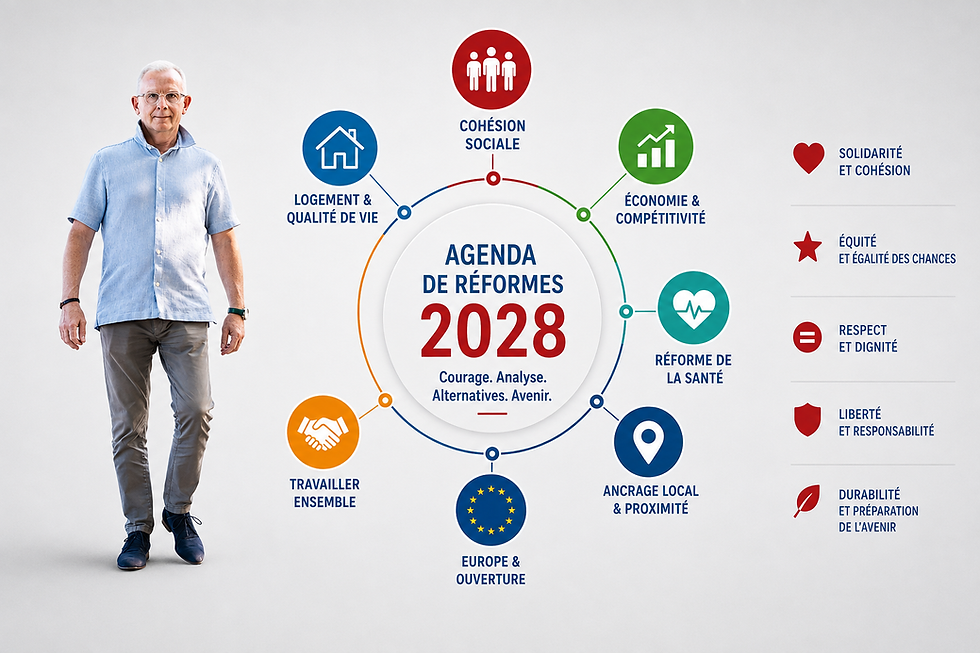
That is why the next step should now follow: a Reform Agenda 2028. It could bridge the gap between the policy programme and the election manifesto, set priorities and make clear which reforms the LSAP intends to use to tackle the challenges of the coming years.
From this triad – the 2026 policy manifesto, the 2028 reform agenda and the subsequent election manifesto – a clear and credible political narrative could emerge. Not as a collection of individual election pledges, but as a common thread for the party’s renewal in terms of substance.
Social democracy should not have to choose between workers and the middle class. It should represent both. Economic strength is not at odds with social justice, but rather a prerequisite for it. Innovation and social cohesion must be considered together.
Equally important is the role of an opposition party. Being in opposition does not mean being fundamentally against everything. It means speaking out where fundamental values are at stake, but working constructively when solutions serve the country’s interests. Anyone who wishes to take on the responsibility of government must demonstrate that they do not merely criticise, but offer better solutions.
The summer recess offers an opportunity to engage in political debates with a degree of perspective. Perhaps now is the right moment to talk less about individuals and more about the future of social democracy in Luxembourg.
I would like to see an LSAP that provides direction, listens, brings different social groups together and has the courage to shape the future. If the current discussions help to advance this process of renewal, they will already have served their purpose.
Social democracy has shaped Luxembourg for decades. It can continue to be a driving force in our country in the future. To do so, it needs the courage to combine its values with a compelling vision for the Luxembourg of tomorrow – and to take the next step following the party’s manifesto: a Reform Agenda 2028 as the path to a strong and credible election programme.


Kommentare