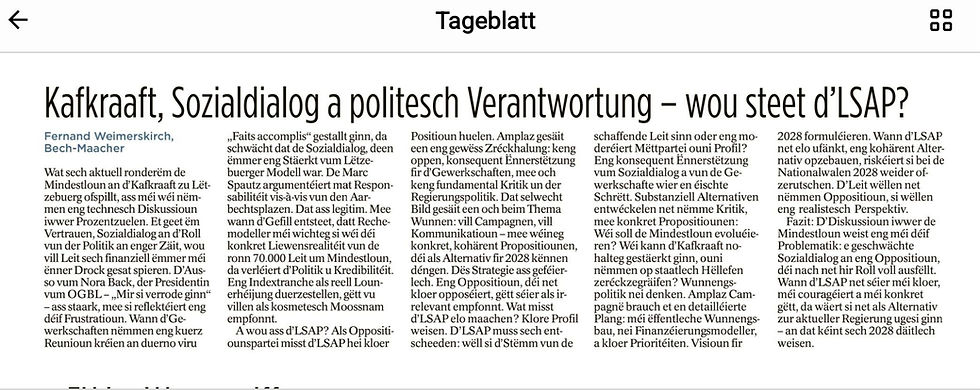
Fernand Weimerskirch calls for a social democratic renewal with clear solutions to the housing crisis – Analysis


The author’s previously published articles essentially revolve around two interlinked issues:
The housing issue as Luxembourg’s key social challenge
The strategic and policy renewal of the LSAP during its first term in opposition since 1999
The author takes the view that the housing issue is not merely a technical problem of construction or the market, but above all a question of social justice. When young families, workers or people on middle incomes can no longer find affordable housing, social cohesion is jeopardised. That is why the LSAP must once again make housing one of its central political priorities. The demand is not merely for ‘more homes’, but for an active public housing and land policy that serves the common good.
At the same time, the author analyses the LSAP’s position following the change of government in 2023. After decades as the ruling party, the party now faces the task, for the first time, of redefining itself as an opposition force. The LSAP must therefore renew its historical role as a social-democratic reform party, sharpen its profile and re-establish itself as a credible political alternative by the 2028 elections. This involves striking a balance between tradition and a fresh start: the fundamental social-democratic values should be preserved, but applied to the challenges of the 21st century.
What does the author aim to achieve?
In a positive sense, the author pursues four objectives:
1. Sharpen the LSAP’s policy agenda
He wishes to prevent the party from merely reacting to current events or defining itself solely through personnel debates. Instead, it should once again be perceived more strongly through its policies – particularly regarding social justice, housing, work and social cohesion.
2. Make constructive use of the time in opposition
The author does not view the role of the opposition as a period of waiting, but as an opportunity for renewal. The years leading up to 2028 should be used to develop policies, initiate debates and regain trust.
3. Strengthen the link to the social democratic identity
Reading between the lines, it becomes clear that he does not view the LSAP as just any centrist party, but as a social democratic force with a special responsibility towards workers, families, tenants and socially vulnerable groups. The party should once again base its arguments more firmly on its historical roots.
4. Developing a reform agenda for Luxembourg
The author thinks beyond the party. His concern is not merely the LSAP’s electoral success, but the question of how Luxembourg can remain socially, economically and socially stable in the long term. The housing issue emerges as a litmus test for whether politics can still solve concrete problems.
The overall tone of the articles is neither nostalgic nor destructive. Rather, it is an attempt by a long-standing LSAP member to spark a debate:
The LSAP should draw strength from its history, renew its social democratic identity and, in particular, make the housing issue a central project, so that by 2028 it is once again perceived as a formative political force.



Links:
Kommentare